
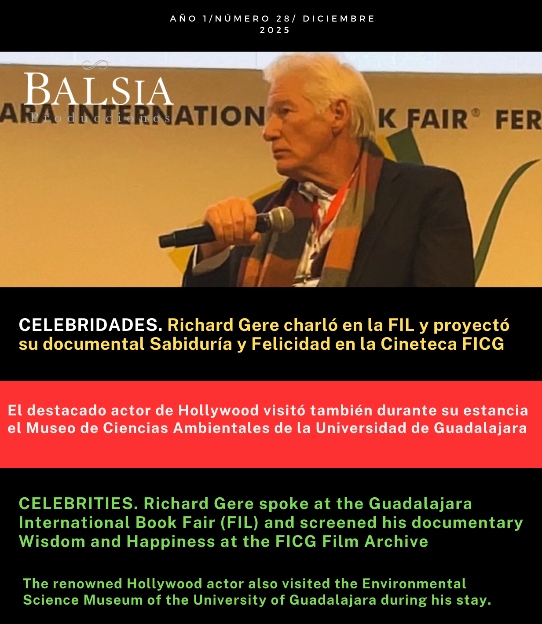



LETRAS. Gael García Bernal del audio libro a la radionovela
LITERATURE. Gael García Bernal: From Audiobook to Radio Drama
El destacado actor mexicano presentó en el Auditorio Juan Rulfo el audiolibro La metamorfosis de Franz Kafka y la radionovela Hilde Krüger
The renowned Mexican actor presented the audiobook of Franz Kafka’s The Metamorphosis and the radio drama Hilde Krüger at the Juan Rulfo Auditorium.

Parte del elenco de La Judea 232 de San Martín de las Flores, Tlaquepaque Foto: ANTONIO SOTO AVILÉS
Luam Vázquez / Guadalajara

El actor mexicano Gael García Bernal presentó en esta edición 39 de la Feria Internacional del Libro de Guadalajara (FIL) audiolibro La metamorfosis (de Franz Kafka) narrado por él, en el que reflexionó sobre el rechazo a lo diferente y la radionovela Hilde Krüger, que retoma la historia de una actriz alemana que se convirtió en espía en la década de los 40 del siglo pasado.
Durante el evento en el Auditorio Juan Rulfo ante cientos de personas que abarrotaron el lugar, García Bernal destacó la relevancia de la voz como herramienta actoral, el reto de construir personajes desde la voz y. el potencial de los formatos sonoros para redescubrir obras literarias fundamentales
Explicó que la grabación de audiolibros y radionovelas implica una intimidad distinta frente al proceso cinematográfico o teatral. Compartió: “Es un espacio muy reconfortante, es solamente concentrarte en la voz que, junto con el cuerpo, son las dos herramientas principales que tenemos como actores para poder interpretar a los personajes. De hecho, eso es lo único que entrenamos realmente”, dijo.
En Hilde Krüger, una radionovela inspirada en la vida de la actriz alemana que pasó a la historia como una espía nazi en México en época de la Segunda Guerra Mundial, García Bernal protagoniza a un periodista.
At the 39th Guadalajara International Book Fair (FIL), Mexican actor Gael García Bernal presented the audiobook The Metamorphosis (by Franz Kafka), narrated by himself, in which he reflected on the rejection of difference, and the radio drama Hilde Krüger, which tells the story of a German actress who became a spy in the 1940s.
During the event at the Juan Rulfo Auditorium, before hundreds of people who filled the venue, García Bernal emphasized the importance of the voice as an acting tool and the challenge of building characters through voice. The potential of audio formats to rediscover fundamental literary works
He explained that recording audiobooks and radio dramas involves a different kind of intimacy compared to the film or theater process. He shared: “It’s a very comforting space; it’s simply concentrating on the voice, which, along with the body, are the two main tools we have as actors to be able to interpret the characters. In fact, that’s the only thing we really train,” he said.
In Hilde Krüger, a radio drama inspired by the life of the German actress who went down in history as a Nazi spy in Mexico during World War II, García Bernal plays a journalist.
FIC 39. La Universidad de Guadalajara otorgó el doctorado Honoris Causa a Leonardo Padura
FIC 39. The University of Guadalajara Awarded an Honorary Doctorate to Leonardo Padura
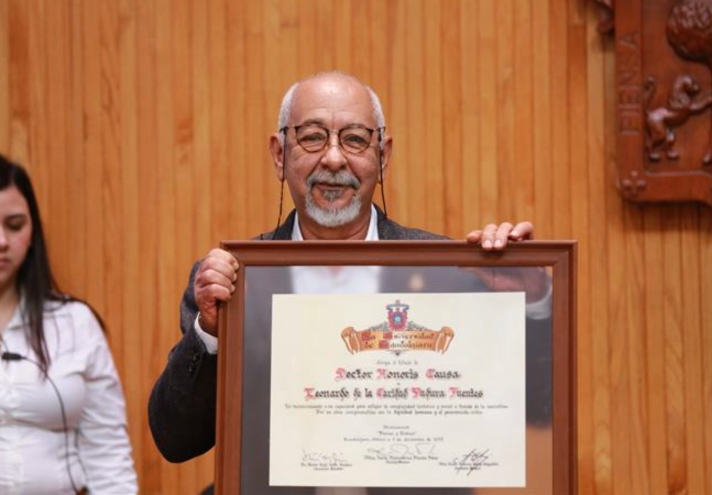
Leonardo Padura Foto:CORTESÍA
Gustavo Rodríguez / Guadalajara
La Universidad de Guadalajara otorgó este 3 de diciembre, el doctorado Honoris Causa a Leonardo Padura en reconocimiento a su contribución al patrimonio cultural y literario de Iberoamérica; su capacidad para reflejar la complejidad histórica y social mediante la narrativa; y su trayectoria como escritor y periodista en la que ha promovido los valores de la libertad, la justicia social y el humanismo.
La Rectora General de la UdeG, maestra Karla Planter Pérez, rectora de esta casa de estudio acreditó como miembro distinguido de esta Casa de Estudio al doctor Leonardo Padura, a quien describió como una de las plumas más lúcidas de nuestro tiempo: “La UdeG se reserva este reconocimiento para personalidades extraordinarias, que a través de sus contribuciones en cualquier área del conocimiento, como la ciencia y las artes, han ennoblecido el trabajo de la humanidad. Hoy, en la 39 edición de la FIL, celebramos su importante contribución literaria y cultural”.
Durante la ceremonia se recordó que Padura ha sito autor de novelas como El hombre que amaba los perros, Adiós, Hemingway y Fiebre de caballos, en las que ha explorado temas como la memoria histórica, la identidad, la corrupción y el exilio, Padura se ha hecho de diversas distinciones a lo largo de su carrera, como el Premio Roger Callois (2011), el Premio Príncipe de Asturias de las Letras (2015), el doctorado Honoris causa por parte de la UNAM (2017) y el Premio Nacional de Literatura de Cuba (2012).
Padura dijo sentirse sorprendido por su trayectoria y agradecido con la UdeG, y sobre todo con el Consejo General Universitario (CGU) de esta Casa de Estudio por darle la oportunidad de ser homenajeado, y junto a su cajetilla de cigarros tradicionales cubanos, el autor contó su primer acercamiento con la Universidad:
“Yo llegué aquí, a la UdeG, por primera vez en 1991; venía a un encuentro narrativo organizado por la Universidad y fue justo ese año cuando gané el concurso de novela que se llamaba ‘Aniversario de la Revolución en Cuba’, mismo que me prometía poder imprimir mi novela Pasado perfecto. Pero un día antes, los organizadores no me permitieron obtener el premio. Pasé en limpio la novela, de máquina a computadora, y a finales de año vine a México a entrevistar a varios personajes musicales y Paco Taibo, a quien le había confiado el manuscrito, me dio un ejemplar impreso de mi novela, editada por la UdeG. Aquella edición tiene erratas hasta en la mirada; estaba mal impreso, hasta mi nombre estaba mal, pero me permitió tener la idea de que era posible seguir trabajando con ese personaje; a partir de ahí, mi relación ha sido muy intensa con la universidad”.
Añadió: “Lo esencial está en Cuba, en mi casa y en mi barrio; todas esas experiencias han formado mi literatura. Ahí encuentro también las respuestas para contestar a mis preguntas y seguir escribiendo”.
The University of Guadalajara awarded on december 3th, an honorary doctorate to Leonardo Padura in recognition of his contribution to the cultural and literary heritage of Ibero-America; his ability to reflect historical and social complexity through narrative; and his career as a writer and journalist in which he has promoted the values of freedom, social justice, and humanism.
The Rector General of the UdeG, Karla Planter Pérez, inducted Dr. Leonardo Padura as a distinguished member of the university, describing him as one of the most insightful writers of our time: “The UdeG reserves this recognition for extraordinary individuals who, through their contributions in any area of knowledge, such as science and the arts, have ennobled the work of humanity. Today, at the 39th edition of the FIL (Guadalajara International Book Fair), we celebrate his important literary and cultural contribution.” During the ceremony, it was noted that Padura is the author of novels such as The Man Who Loved Dogs, Goodbye, Hemingway, and Horse Fever, in which he has explored themes such as historical memory, identity, corruption, and exile. Padura has received numerous distinctions throughout his career, including the Roger Caillois Prize (2011), the Prince of Asturias Award for Literature (2015), an honorary doctorate from the National Autonomous University of Mexico (UNAM) (2017), and the National Literature Prize of Cuba (2012).
Padura said he was surprised by his career trajectory and grateful to the University of Guadalajara (UdeG), and especially to the University General Council (CGU) for giving him the opportunity to be honored. With his pack of traditional Cuban cigars in hand, the author recounted his first encounter with the University:
“I arrived here at the UdeG for the first time in 1991; I came for a narrative event organized by the University, and it was precisely that year that I won the novel contest called ‘Anniversary of the Revolution in Cuba,’ which promised to allow me to publish my novel, Pasado perfecto (Past Perfect). But the day before, the organizers wouldn’t let me accept the prize. I typed up the novel, from typewriter to computer, and at the end of the year I came to Mexico to interview several musical figures, and Paco Taibo, to whom I had entrusted the manuscript, gave me a printed copy of my novel, published by the UdeG. That edition has typos everywhere; it was badly printed, even my name was wrong, but I It allowed me to see that it was possible to continue working with that character; from then on, my relationship with the university has been very intense.”
He added: “The essential elements are in Cuba, in my home and in my neighborhood; all those experiences have shaped my writing. There I also find the answers to my questions and continue writing.”
FIL39. Rinden homenaje póstumo a Julieta Fierro
FIL39. Posthumous Tribute to Julieta Fierro
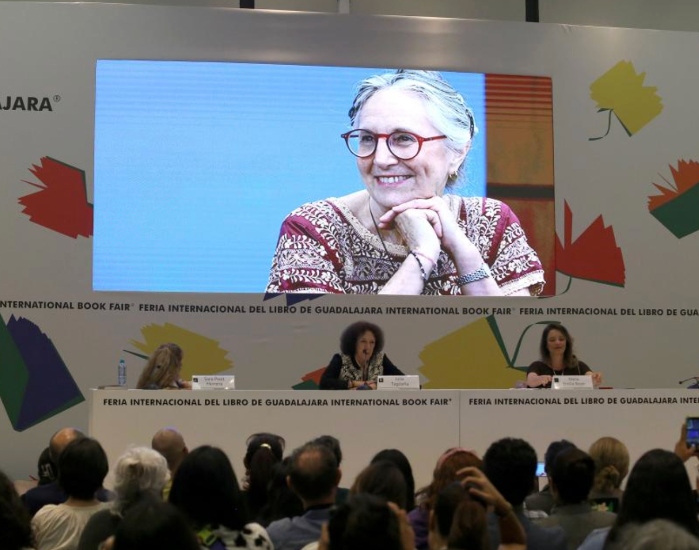
Algunos momentos del homenaje Foto:CORTESÍA
Juan Carlos Núñez/ Guadalajara
Una de las actividades destacadas del programa FIL Ciencia 2025, fue el homenaje póstumo que se rindió este 2 de diciembre, a Julieta Fierro, bajo el nombre de Julieta Fierro: Una estrella para siempre.
La investigadora Julia Tagüeña, recordó a la astrónoma Julieta Fierro como una gran pionera de la divulgación científica en una época en que el ámbito científico era muy cerrado para las mujeres, razón por la cuál, representó un gran acontecimiento que invitaran a Fierro a crear el Museo Universum de la UNAM y que su revista ¿Cómo ves? Ganara fuese cada vez más popular.
“Creo que sí perteneció a una generación en muchos sentidos pionera, que rompió muchas reglas en nuestro país y en el mundo. En ese sentido Julieta siempre muy promotora de la libertad de las mujeres, por supuesto que era feminista”, enfatizó.
El legado de la astrofísica trascendió esa ciencia y se apoyó en otras disciplinas como la literatura, cuyo valor le valió ser reconocida como una integrante más de la Academia Mexicana de la Lengua, rememoró la escritora Sara Poot Herrera.
María Emilia Beyer, divulgadora y directora del Museo Universum, leyó una carta de los hijos de Julieta Fierro, quienes recordaron las enseñanzas de su madre y su pasión por compartir los misterios del Universo y agradecieron a la FIL por ser un espacio en el que la astrónoma se encontraba con miles de curiosos.
One of the highlights of the FIL Science 2025 program was the posthumous tribute paid on December 2nd to Julieta Fierro, under the name Julieta Fierro: A Star Forever.
Researcher Julia Tagüeña remembered astronomer Julieta Fierro as a great pioneer of science communication at a time when the scientific field was very closed to women. For this reason, it was a significant event when Fierro was invited to create the Universum Museum at UNAM and when her magazine, ¿Cómo ves? Ganara, became increasingly popular.
«I believe she did belong to a generation that was pioneering in many ways, breaking many rules in our country and around the world. In that sense, Julieta was always a great promoter of women’s freedom; of course, she was a feminist,» she emphasized.
The astrophysicist’s legacy transcended that science and extended to other disciplines such as literature, whose value earned her recognition as a member of the Mexican Academy of Language, recalled writer Sara Poot Herrera.
María Emilia Beyer, science communicator and director of the Universum Museum, read a letter from Julieta Fierro’s children, who remembered their mother’s teachings and her passion for sharing the mysteries of the Universe and thanked the Guadalajara International Book Fair (FIL) for being a space where the astronomer met with thousands of curious minds.
FIL39. Rita Segato habló del conflicto de Gaza en Voces Inquebrantables
FIL39. Rita Segato spoke about the Gaza conflict at Unbreakable Voices
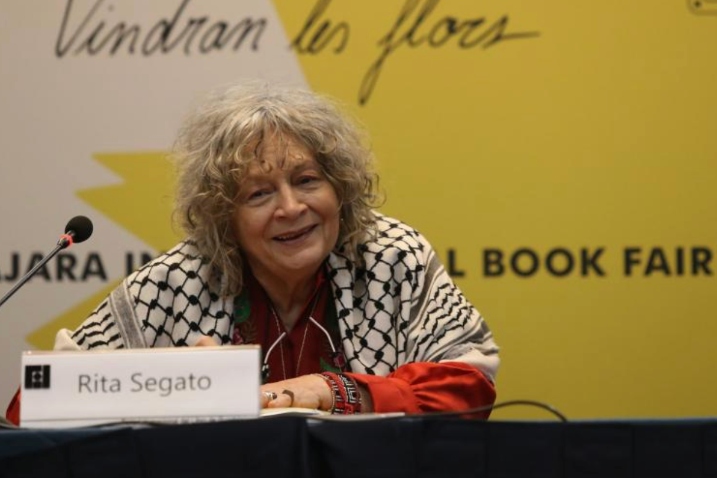
La escritora Rita Segato. Foto:CORTESÍA
Asdrúbal Ruiz / Guadalajara
Rita Segato dijo que en Gaza prevalece la ley del poder de la muerte porque el mundo cierra los ojos ante el asesinato de cientos de personas, incluidas niñas y niños y una casi nula conciencia humanitaria, en el conversatorio de clausura del programa Voces Inquebrantables, organizado el 30 de noviembre por el Programa de Fomento a la Lectura “Letras para Volar” y como parte del programa FIL Pensamiento de la Universidad de Guadalajara.
Segato aseguró que la humanidad perdió la «ficción jurídica», que explicó como un pacto de fe en la ley que, aunque siempre fue imperfecto, solía regir la convivencia global. Esa ficción no está ya ni en el conflicto en Gaza ni en las nuevas guerras del mundo, pero sí ha revelado una realidad donde la única regla vigente es la capacidad de matar.
La activista feminista y referente en el análisis de la violencia afirmó que el mundo entró en una nueva era a la que denominó D.G. (después de Gaza), en una similitud con el antes de Cristo (D.C.), momento a como se conoce al inicio de la era cristiana.
También habló del caso de Gisele Pellicot, en Francia, cuyo esposo la drogaba para prostituirla sin su consentimiento, además de grabarla y subir los videos a internet. Dijo que el crimen responde a actos políticos que utilizan al cuerpo de las mujeres para obedecer el mandato de masculinidad, en la que los hombres deben demostrar su hombría ante sus pares mediante algún tipo de violencia, en una especie de lealtad en cofradía”.
Este patrón se repite en el caso de Jeffrey Epstein, quien tenía una red internacional de trata de mujeres, la mayoría menores de edad captadas de maneras engañosas para ser prostituidas por cientos de hombres con alto poder adquisitivo, muchos de ellos con cargos públicos de renombre como el presidente Donald Trump y el príncipe Andrés de Inglaterra, detalló.
Rita Segato said that in Gaza the law of the power of death prevails because the world turns a blind eye to the murder of hundreds of people, including children, and to a near-total lack of humanitarian awareness. She made these remarks during the closing discussion of the Unbreakable Voices program, organized on November 30 by the «Letters to Fly» Reading Promotion Program and as part of the FIL Thought program of the University of Guadalajara.
Segato asserted that humanity has lost the «legal fiction,» which she explained as a pact of faith in the law that, although always imperfect, used to govern global coexistence. This fiction is no longer present in the conflict in Gaza or in the new wars around the world, but it has revealed a reality where the only rule in force is the capacity to kill.
The feminist activist and leading figure in the analysis of violence affirmed that the world has entered a new era, which she called D.G. (After Gaza), in a parallel with BC, the period known as the beginning of the Christian era.
He also spoke about the case of Gisele Pellicot in France, whose husband drugged her to force her into prostitution without her consent, in addition to recording her and uploading the videos to the internet. He said that the crime stems from political acts that use women’s bodies to uphold the mandate of masculinity, in which men must prove their manhood to their peers through some form of violence, in a kind of brotherhood loyalty.
This pattern is repeated in the case of Jeffrey Epstein, who ran an international human trafficking network, most of the victims being minors lured under false pretenses to be prostituted by hundreds of wealthy men, many of them prominent public figures such as President Donald Trump and Prince Andrew of England, he explained.








 balsiaproducciones.com.mx