
THEATER. La Luciérnaga begins national tour of Eréndira, the Impossible
El colectivo originario de Michoacán lleva este unipersonal que aborda la historia inspirada en la leyenda de la guerrera purépecha que resistió la conquista. La obra se presentará en Jalisco, Guanajuato, Yucatán y Quintana Roo durante marzo y abril
The Michoacán-based collective presents this one-woman show, which tells the story inspired by the legend of the Purépecha warrior who resisted the conquest. The play will be performed in Jalisco, Guanajuato, Yucatán, and Quintana Roo during March and April
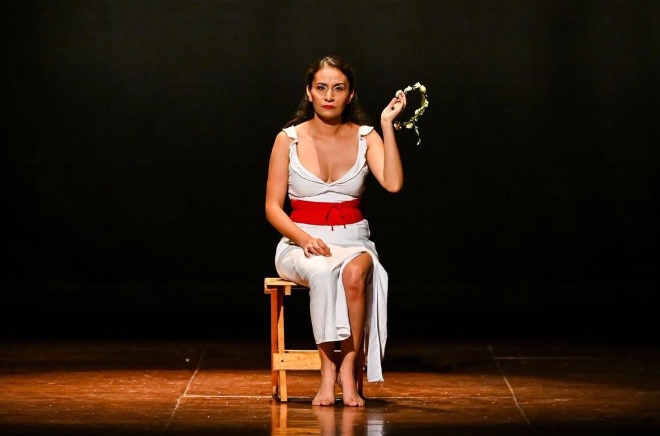
Verónica Villicaña escribió, dirige y actúa Eréndira, La imposible: Fotos. CLAUDIA ANDALÓN
Enrique Vázquez Lozano/ Guadalajara

Eréndira, la imposible es el unipersonal que combina historia y leyenda, del colectivo La Luciérnaga de Michoacán, que se presenta este miécoles 4 y jueves 5 de marzo en El Venero Foro- Teatro – Galería y con ello inicia una gira nacional por otros foros de Nayarit, Guanajuato, Yucatán y Quintana Roo.
Eréndira está inspirado en las heroínas anónimas que resistieron el saqueo de los conquistadores españoles. “Fue una mujer indígena cuando llegaron los españoles defendió el territorio y fue la primera en montar un caballo que le permitió liderar la independencia. En Michoacán es una de las leyendas más populares y me pareció interesante investigar acerca de ella para crear esta obra. Al principio creí que podría funcionar bien como una obra para adolescentes o niños, sin embargo conforme encontré información vi que la historia implicaba tratarla con otra complejidad y al final quedó una obra para mayores de 15 años por los temas que trata”, dijo Verónica Villicaña, actriz, dramaturga y directora de esta puesta escénica que cuenta con la producción de Sandra Meneses, música de Beto León, e iluminación y multimedia de Everth Yamil García Islas.
Villicaña compartió que la obra cuenta con el apoyo de PECDA Michoacán 2023, y seleccionado por el Festival Internacional de Artes Escénicas Querétaro, y por Festival de Otoño Xonaca, en Puebla. En 2025 formó parte del XX Festival de Monólogos Teatro A Una Sola Voz, y del XXIV Festival de octubre de Baja California Territorios de Paz, con lo cual hasta el momento ya se ha presentado en 11 estados del país.
Eréndira es una joven purépecha, a la que no le basta ser una de varias esposas del Cazonci y madre de muchos hijos. Se siente prisionera y sueña con escapar; cuando la llegada de los españoles a Mechuacán desata el caos y la destrucción, Eréndira tendrá que emerger como la mujer de una nueva era. “La historia aunque es ficción abona a una visión menos centralista de la Historia de México. Generalmente cuando nos hablan de la conquista nos hablan de Tenochtitlán, sin tomar en cuenta que en esa época había muchos otros pueblos importantes a lo largo del país con una estructura social sólida y una cultura y religiones propias como lo fue el reino Purépecha. La historia oficial ha relegado la historia de pueblos como el Purépecha y estamos muy satisfechos de contar con herramientas escénicas para contar historias de nuestra región y llevarlas fuera del estado en donde son poco conocidas. Para la música que acompaña la obra, Beto León compuso varias pirecuas que le dan un carácter particular a la obra en general”.
La directora, dramaturga y actriz compartió que el colectivo La Luciérnaga se fundó hace doce años y que su línea de trabajo siempre ha sido representar textos propios. “Sólo hemos realizado un montaje del poblano Rafa de la Cruz. Hasta el momento hemos realizado doce producciones y también hemos tratado hacer títeres y teatro para adolescentes, esta obra es la excepción como ya lo mencioné”….
FECHAS DE LA GIRA
Marzo 2026
Guadalajara, Jalisco
El Venero Foro-Teatro-Galería. Ubicado en C. Reforma 508 – A, en Guadalajara.
Miércoles 4 de marzo a las 20:00 horas
Jueves 5 de marzo a las 20:00 horas
Boletos $200.00
Tepic, Nayarit
Laboratorio de Arte Teatral y Escénico de
Nayarit LATEN
Viernes 6 de marzo a las 19:00 horas
Sábado 7 de marzo a las 19:00 horas
Boletos $100.00
San Miguel de Allende, Guanajuato
El Sindicato. Centro Cultura Comunitario
Jueves 12 de marzo a las 19:00 horas
Viernes 13 de marzo a las 11:00 horas
$100.00
Merida, Yucatán
Centro Cultural Olimpo
Miércoles 15 de abril a las 19:00 horas
Jueves 16 de abril a las 11:00 horas
Entrada libre
Cancún, Quintana Roo
Teatro 8 de octubre
Sábado 18 de abril a las 19:00 horas
Domingo 19 de abril a las 18:00 horas
Entrada libre
Chetumal, Quintana Roo
Foro 21 Espacio Cultural Independiente
Jueves 23 de abril a las 20:00 horas
Viernes 24 de abril a las 20:00 horas
Boletos $150.00
Eréndira, the Impossible is a solo performance that combines history and legend, by the Michoacán-based collective La Luciérnaga. It will be presented this Wednesday, March 4, and Thursday, March 5, at El Venero Foro-Teatro-Galería, kicking off a national tour that will also include other venues in Nayarit, Guanajuato, Yucatán, and Quintana Roo.
Eréndira is inspired by the anonymous heroines who resisted the plundering of the Spanish conquistadors. “She was an Indigenous woman who defended her territory when the Spanish arrived, and she was the first to ride a horse, which allowed her to lead the independence movement. In Michoacán, she is one of the most popular legends, and I found it interesting to research her story to create this play. At first, I thought it might work well as a play for teenagers or children; however, as I found more information, I saw that the story required a different level of complexity, and in the end, it became a play for audiences over 15 years old due to the themes it addresses,” said Verónica Villicaña, actress, playwright, and director of this stage production, which features production by Sandra Meneses, music by Beto León, and lighting and multimedia by Everth Yamil García Islas.
Villicaña shared that the play has received support from PECDA Michoacán 2023 and has been selected by the Querétaro International Performing Arts Festival and the Xonaca Autumn Festival in Puebla. In 2025, she participated in the 20th One-Voice Theater Monologue Festival and the 24th Baja California Territories of Peace October Festival, bringing her total to 11 states across the country.
Eréndira is a young Purépecha woman for whom being one of the Cazonci’s many wives and mother of numerous children is not enough. She feels imprisoned and dreams of escape. When the arrival of the Spanish in Michoacán unleashes chaos and destruction, Eréndira will have to emerge as the woman of a new era. “Although the story is fiction, it contributes to a less centralist view of Mexican history. Generally, when we hear about the conquest, we hear about Tenochtitlán, without taking into account that at that time there were many other important peoples throughout the country with a solid social structure and their own culture and religions, such as the Purépecha kingdom. Official history has relegated the history of peoples like the Purépecha, and we are very pleased to have theatrical tools to tell stories from our region and take them beyond the state, where they are little known. For the music that accompanies the play, Beto León composed several pirecuas that give a particular character to the work as a whole.”
The director, playwright, and actress shared that the La Luciérnaga collective was founded twelve years ago and that its line of work has always been to perform its own texts. “We have only staged one production by Rafa de la Cruz from Puebla. To date, we have produced twelve plays, and we have also tried our hand at puppetry and theater for teenagers; this play is the exception, as I already mentioned…”
TOUR DATES
March 2026
Guadalajara, Jalisco
El Venero Forum-Theater-Gallery. Located at Reforma 508-A, Guadalajara.
Wednesday, March 4 at 8:00 p.m.
Thursday, March 5 at 8:00 p.m.
Tickets $200.00
Tepic, Nayarit
Laboratory of Theatrical and Performing Arts of Nayarit (LATEN)
Friday, March 6 at 7:00 p.m.
Saturday, March 7 at 7:00 p.m.
Tickets $100.00
San Miguel de Allende, Guanajuato
El Sindicato Community Cultural Center
Thursday, March 12 at 7:00 p.m.
Friday, March 13 at 11:00 a.m.
$100.00
Merida, Yucatán
Olimpo Cultural Center
Wednesday, April 15 at 7:00 p.m.
Thursday, April 16 at 11:00 a.m.
Free admission
Cancún, Quintana Roo
October 8 Theater
Saturday, April 18 at 7:00 p.m.
Sunday, April 19 at 6:00 p.m.
Free admission
Chetumal, Quintana Roo
Foro 21 Independent Cultural Space
Thursday, April 23 at 8:00 p.m.
Friday, April 24 at 8:00 p.m.
Tickets $150.00








 balsiaproducciones.com.mx