El Ciclo que reúne 14 películas provenientes de América Latina, Europa y Asia puede disfrutarse en la CDMX del 12 de febrero al 1 de marzo y posteriormente en varias ciudades del país
The series, featuring 14 films from Latin America, Europe, and Asia, can be enjoyed in Mexico City from February 12 to March 1, and later in various cities throughout the country.
Poster. Fotos: CORTESÍA
Claudia Andalón / Guadalajara
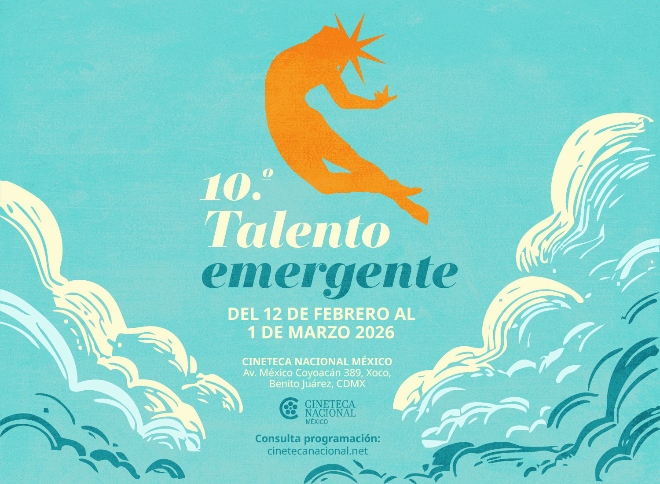
Las sedes de la Cineteca Nacional de Chapultepec y de las Artes de la Ciudad de México, presentan el ciclo Talento Emergente que se realiza del 12 de febrero al 1 de marzo y que se conforma de 14 títulos que van desde ficciones a documentales, lo mismo que cintas de animación provenientes de América Latina, Europa y Asia.
Dicho ciclo llegará posteriormente a distintos lugares de la República Mexicana a través del Circuito Cineteca. Las fechas y horarios específicos de las funciones podrán consultarse a través de los canales oficiales de la Cineteca Nacional
The National Film Archive (Cineteca Nacional) in Chapultepec and the Arts Center in Mexico City present the Emerging Talent series, running from February 12 to March 1. The series comprises 14 titles, ranging from fiction and documentaries to animation, from Latin America, Europe, and Asia.
This series will later travel to different locations throughout Mexico via the Cineteca Circuit. Specific dates and times of screenings can be found on the official Cineteca Nacional channels.
1 El diablo fuma (y guarda las cabezas de los cerillos quemados en la misma caja), (México, 2025), ópera prima de Ernesto Martínez Bucio
Se trata de la película ganadora del Premio a la Mejor Ópera Prima en el Festival de Cine de Berlín. Ambientada en el México de los años noventa, la película sigue a cinco hermanos que, tras la desaparición de sus padres, quedan al cuidado de su abuela. Entre la angustia y la imaginación, el filme evoca los miedos infantiles y los traumas familiares mediante una puesta en escena intensa y una notable energía interpretativa.
This film won the Best First Feature Award at the Berlin International Film Festival. Set in 1990s Mexico, the film follows five siblings who, after their parents disappear, are left in the care of their grandmother. Between anguish and imagination, the film evokes childhood fears and family traumas through intense staging and remarkable acting energy.
2.- La misteriosa mirada del flamenco (Chile-Francia-Alemania-España-Bélgica, 2025), debut en el largometraje de Diego Céspedes.
Concebida como un poético western moderno, la película narra la historia de una niña que crece en un pueblo minero del desierto chileno junto a su familia de mujeres trans, enfrentando el machismo, la ignorancia y la violencia desde la solidaridad, la magia y los afectos.
Conceived as a poetic modern western, the film tells the story of a girl who grows up in a mining town in the Chilean desert with her family of trans women, facing machismo, ignorance and violence through solidarity, magic and affection.
3.- El silencio de Julie (Bélgica-Suiza, 2024), primera película de Leonardo Van Dijl.
A través de la historia de una joven tenista inmersa en un entorno de alta exigencia, el filme aborda el abuso de poder y la presión social desde una perspectiva contenida, donde el silencio se convierte en una forma de resistencia y expresión.
Through the story of a young tennis player immersed in a highly demanding environment, the film addresses the abuse of power and social pressure from a restrained perspective, where silence becomes a form of resistance and expression.
4.- Olivia & las nubes (República Dominicana, 2024), ópera prima de Tomás Pichardo-Espaillat.
Mediante un universo visual colorido y multifacético que combina técnicas como 2D, stop motion, cutout y filmaciones en Súper 8, la película explora distintas formas del amor, la pérdida y el recuerdo, apostando por el surrealismo y la abstracción como lenguajes emocionales.
Through a colorful and multifaceted visual universe that combines techniques such as 2D, stop motion, cutout and Super 8 filming, the film explores different forms of love, loss and memory, opting for surrealism and abstraction as emotional languages.
5.-Vivir la tierra (2025), debut de Meng Huo desde Chile.
Ambientada en la China rural de los años noventa, la película observa con paciencia el crecimiento de un niño en medio de profundas transformaciones sociales y económicas, reflexionando sobre el vínculo entre el ser humano y el territorio.
Set in rural China in the 1990s, the film patiently observes a child’s growth amid profound social and economic transformations, reflecting on the link between human beings and the land.
6.- Li cham (México, 2025), ópera prima de la cineasta tzotzil Ana Ts’uyeb
La cinta fue ganadora del premio a Mejor Largometraje Documental en el Festival Internacional de Cine de Morelia y retrata el proceso de renacimiento político y afectivo de mujeres indígenas chiapanecas a partir de la memoria, la defensa del territorio y la esperanza colectiva.
The film won the Best Documentary Feature award at the Morelia International Film Festival and portrays the process of political and emotional rebirth of indigenous women from Chiapas through memory, the defense of their territory, and collective hope.
7.- Los inocentes (Perú-México, 2025), de Germán Tejada
En este filme, Tejeda adapta la obra homónima de Oswaldo Reynoso en un coming of age crudo y directo. Ambientada en el Perú de la actualidad, la película retrata a una juventud atravesada por la violencia, la marginalidad y la búsqueda de identidad, apoyándose en una estética punk, un fuerte realismo social y una contestataria propuesta sonora.nza colectiva.
In this film, Tejada adapts Oswaldo Reynoso’s novel of the same name into a raw and direct coming-of-age story. Set in contemporary Peru, the film portrays a generation of young people grappling with violence, marginalization, and the search for identity, employing a punk aesthetic, a strong social realism, and a defiant sound design.
8.- El sueño de la sultana (España-Alemania-India, 2023), película animada de Isabel Herguera.
Inspirada en la obra de Begum Rokeya Hossain, la película combina técnicas artesanales como la acuarela, la tinta y el teatro de sombras para dar forma a un relato feminista que dialoga entre la experiencia personal, la historia y la imaginación utópica.
Inspired by the work of Begum Rokeya Hossain, the film combines artisanal techniques such as watercolor, ink, and shadow theater to shape a feminist narrative that engages in dialogue between personal experience, history, and utopian imagination.
9.- Kix: El rey de las calles (Hungría-Francia-Croacia, 2024) de los directores Dávid Mikulán y Bálint Révész
En esta película los directores documentan durante más de una década la vida de Sanyi, un niño que crece en las calles de Budapest. Con un estilo punk y un realismo crudo, el filme construye un retrato íntimo y cautivador sobre la infancia y la exclusión social.
In this film, the directors document the life of Sanyi, a boy growing up on the streets of Budapest, over more than a decade. With a punk aesthetic and raw realism, the film constructs an intimate and captivating portrait of childhood and social exclusion.
10.- Say Goodbye (México, 2025), de Paloma López Carrillo.
El documental mexicano, ofrece un retrato íntimo de una familia marcada por la desaparición de un padre tras su deportación. A través de una puesta en escena observacional y un ritmo pausado, la película aborda el duelo, la ausencia y las huellas emocionales que deja la pérdida.
The Mexican documentary offers an intimate portrait of a family marked by the disappearance of a father following his deportation. Through observational staging and a measured pace, the film explores grief, absence, and the emotional scars left by loss.
11.- Una quinta portuguesa (2025), segundo largometraje de la cineasta veneciana Avelina Prat.
Desde Portugal y España, la película sigue a un hombre que, tras la desaparición voluntaria de su esposa, emprende un viaje que lo lleva a replantearse su identidad y la posibilidad de comenzar de nuevo.
Set in Portugal and Spain, the film follows a man who, after the voluntary disappearance of his wife, embarks on a journey that leads him to reconsider his identity and the possibility of starting over.
12.- Salam (Uruguay, 2024), la directora Agustina Willat García
La cinta documenta el encuentro entre cineastas uruguayos y jóvenes saharauis en un campamento de refugiados en el Sahara occidental. El filme reflexiona sobre el cine como herramienta de memoria, resistencia y transmisión cultural frente al exilio y el olvido.
The film documents the encounter between Uruguayan filmmakers and young Sahrawis in a refugee camp in Western Sahara. It reflects on cinema as a tool for memory, resistance, and cultural transmission in the face of exile and oblivion.
13.- Memorias de un cuerpo que arde (Costa Rica-España, 2024), de Antonella Sudasassi Furniss,
Se trata de una obra que mezcla documental y ficción para reflexionar sobre el cuerpo, el deseo y la memoria femenina, reivindicando el derecho a sentir y gozar más allá de las imposiciones sociales
This work blends documentary and fiction to reflect on the female body, desire, and memory, asserting the right to feel and enjoy beyond social impositions.
En esta cinta Fernández Prieto reconstruye la vida del buzo y explorador francés Henri García, antiguo tripulante del documentalista marino Jacques-Yves Cousteau. A través de material de archivo y recuerdos familiares, la película propone una reflexión íntima sobre la contemplación, la conservación del entorno natural y la relación del ser humano con el mar.
In this film, Fernández Prieto reconstructs the life of French diver and explorer Henri García, a former crew member of marine documentary filmmaker Jacques-Yves Cousteau. Through archival footage and family memories, the film offers an intimate reflection on contemplation, the conservation of the natural environment, and the relationship between humankind and the sea.

SCIENCE. Starry Night 2025 Celebrates the Centenary of the Development of Quantum Mechanics
La edición 17 de este encuentro de divulgación científica se realiza el 29 de noviembre en 120 sedes de México y Guatemala
The 17th edition of this science outreach event takes place on November 29th at 120 venues in Mexico and Guatemala
En Guadalajara se pondrán a disposición 35 telescopios para observar el espacio/ In Guadalajara, 35 telescopes will be available for observing space.Foto. CORTESÍA
Enrique Vázquez Lozano / Guadalajara
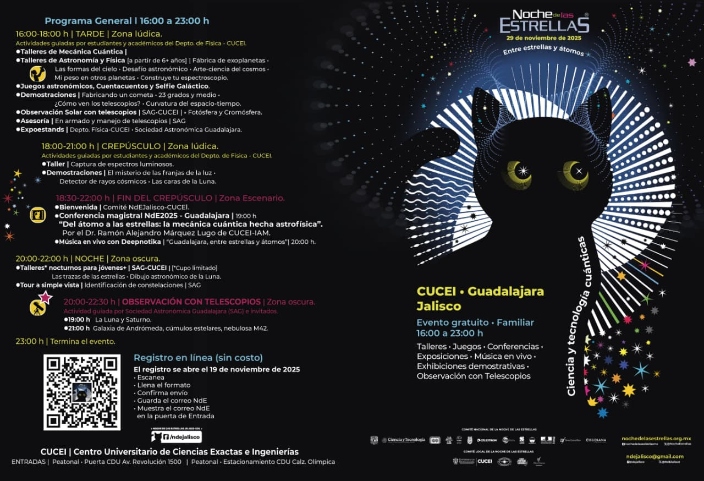
La Noche de las estrellas se realiza este 29 de noviembre en todo el país y en Guatemala, con un total de 120 sedes y por décimo séptima ocasión consecutiva, la fiesta astronómica más importante de América Latina, de las cuáles en Guadalajara la sede será el Centro Universitario de Ciencias Exactas e Ingenierías de la Universidad de Guadalajara de las 16:00 a las 22:00 horas, según anunció en entrevista Gerardo Rizo, colaborador de Balsia Producciones y miembro de la Mesa Directiva de la Sociedad Astronómica de Guadalajara (SAG), una de las asociaciones organizadores desde 2009.
Entre las particularidades de este año es que se celebra el Año Internacional de la Ciencia y la Tecnología Cuánticas a 100 años del inicio del desarrollo de esta ciencia que en palabras de Rizo: “está revolucionando nuestra comprensión del cosmos y transformando nuestra vida diaria con tecnologías como la criptografía y la medicina avanzada. En este 2025, a 100 años del inicio del desarrollo de la física cuántica, astrónomos profesionales y aficionados, divulgadores de la ciencia, estudiantes y profesores de carreras científicas, así como el público en general, se reunirán para observar el cielo, disfrutar de la ciencia y celebrar la forma en la que la ciencia y las tecnologías cuánticas han impactado nuestra vida”.
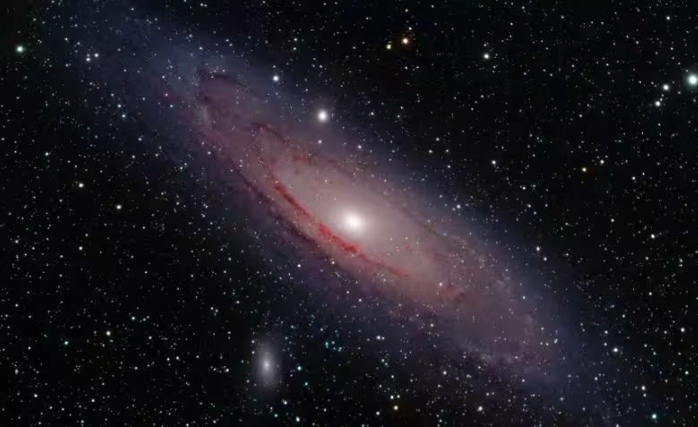
Rizo compartió que “en Guadalajara al ser sede el CUCEI de la UdeG, participarán alumnos y profesores del con la realización de diversos talleres simultáneos relacionados con la Física Cuántica, de diferentes niveles, algunos ideados para niños y otros para expertos. La conferencia central la dará Alejandro Márquez Lugo sobre Física cuántica. Se espera contar con 35 telescopios para realizar observación de las 20:00 a las 23:00 horas en que finalizará el evento y aunque no se podrá ver objetos de cielo profundo, debido a que el cielo contaminado en ciudad no lo permite, sí será posible ver Saturno, la luna, la nebulosa de Orión y la Galaxia Andrómeda. Estamos preparados para recibir hasta 3 mil 500 personas que fue la afluencia que tuvimos el año pasado”.
También se hará una actividad titulada Dibuja la luna. Habrá tres telescopios disponibles para quienes quieran dibujar la luna y al final los organizadores sellarán su dibujo para que constate que lo hicieron en el momento”. Otras actividades que destacan en el programa entre charlas y cuentacuentos, son la participación de grupos de rock de profesores del CUCEI y el grupo Deepnótika que compuso un tema original para este encuentro”.
Starry Night takes place this November 29th throughout Mexico and Guatemala, with a total of 120 venues. For the seventeenth consecutive year, it is the most important astronomical event in Latin America. In Guadalajara, the venue will be the University Center for Exact Sciences and Engineering of the University of Guadalajara, from 4:00 PM to 10:00 PM, as announced in an interview by Gerardo Rizo, collaborator of Balsia Productions and member of the Board of Directors of the Astronomical Society of Guadalajara (SAG), one of the organizing associations since 2009.
Among the special features of this year is the celebration of the International Year of Quantum Science and Technology. One hundred years since the beginning of the development of this science, which, in Rizo’s words, “is revolutionizing our understanding of the cosmos and transforming our daily lives with technologies such as cryptography and advanced medicine. In 2025, the centenary of the beginning of quantum physics, professional and amateur astronomers, science communicators, students and professors of science disciplines, as well as the general public, will gather to observe the sky, enjoy science, and celebrate how quantum science and technologies have impacted our lives.”
Rizo shared that “in Guadalajara, with the CUCEI (University of Guadalajara’s Center for Exact Sciences and Engineering) hosting the event, students and professors will participate in various simultaneous workshops related to Quantum Physics, at different levels, some designed for children and others for experts. The keynote address will be given by Alejandro Márquez Lugo on Quantum Physics. We expect to have 35 telescopes available for observation from 8:00 PM to 11:00 PM, when the event will conclude. Although deep-sky objects will not be visible due to the city’s light pollution, it will be possible to see Saturn, the moon, the Orion Nebula, and the Andromeda Galaxy. We are prepared to receive up to 3,500 people, which was the attendance we had last year.”
An activity titled “Draw the Moon” will also be offered. Three telescopes will be available for those who want to draw the moon, and at the end, the organizers will stamp their drawings to verify that they were done on the spot. Other highlights of the program, in addition to talks and storytelling, include performances by rock bands made up of professors from CUCEI and the group Deepnótika, who composed an original song for this event.
PROGRAMA
ACTIVIDADES QUE SE REALIZARÁN EN OTRAS ENTIDADES
En la Ciudad de México y su área conurbada habrá doce sedes para la atención del público: Las Islas de Ciudad Universitaria, UNAM, con actividades de las 15 a las 22 horas; el Planetario Luis Enrique Erro y el Museo Tezozomoc, ambos del IPN, también con el horario mencionado. El Museo de Historia Natural (Chapultepec); el Bosque de Tláhuac; el plantel San Lorenzo Tezonco de la Universidad Autónoma de la Ciudad de México (Iztapalapa); la Casa de la Cultura del Parque Naucalli; el Tecnológico de Estudios Superiores (TecNM) de Ecatepec; el parque de la Torre Naranja de Geovillas de Santa Bárbara en Ixtapaluca; el Planetario Digital de Chimalhuacán; el Centro Cultural Mexiquense Bicentenario de Texcoco; y el Museo Chinampaxóchitl (Parque ecológico de Xochimilco).
NOCHE DE LAS ESTRELLAS 2025 ENTRE ESTRELLAS Y ÁTOMOS
Este año fue declarado por la ONU como el Año Internacional de la Ciencia y la Tecnología Cuánticas para conmemorar el centenario del inicio del desarrollo de la mecánica cuántica. En 1925 Werner Heisenberg publicó la primera formulación de una teoría que sentó la base para entender el comportamiento de los fenómenos a escala atómica y subatómica. En la década de 1920, personajes como Heisenberg, Erwin Schrödinger, Max Born, Wolfgang Pauli y Louis de Brougli desarrollaron los principios que en 2025 han pasado de ser ideas interesantes a formar uno de los pilares de la física contemporánea y dar lugar a nuevas tecnologías que hemos incorporado en nuestra vida cotidiana. El desarrollo de los transistores, que son la base del funcionamiento de nuestros celulares, es un claro ejemplo de estas tecnologías.
Por otro lado, la ciencia cuántica ha sido esencial para la comprensión de los fenómenos fundamentales del Universo. La mecánica cuántica es la única herramienta que permite describir los procesos que hacen que las estrellas, como nuestro Sol, brillen, así como los procesos que ocurrieron en los instantes posteriores al Big Bang cuando se formaron los primeros átomos en el Universo. La ciencia cuántica también es esencial para el entendimiento de la fenomenología de los objetos cósmicos más enigmáticos, los agujeros negros.
Además, en este 2025 tenemos muchas otras cosas que celebrar. En primer lugar a dos mujeres muy importantes en el desarrollo de la astronomía: 275 aniversario del natalicio de Caroline Herschel, la primera mujer en obtener un puesto de astrónoma profesional remunerado y contribuir en el descubrimiento e identificación de miles de objetos; y el 100 aniversario del natalicio de Nancy Roman, primera Jefa de Astronomía de la NASA y quien fue fundamental para poner en órbita al Telescopio Espacial Hubble, instrumento que revolucionó nuestra visión del Universo. En segundo lugar, celebramos tres aniversarios de transformaciones en nuestra comprensión del universo: 60 aniversario del descubrimiento de la Radiación Cósmica de Fondo, que muestra la luz de las primeras etapas del Universo; los 10 años del descubrimiento de las Ondas Gravitacionales, una predicción de la Teoría de la Relatividad General formulada por Albert Einstein; y el décimo aniversario de la inauguración del Observatorio de Rayos Gamma HAWC, el cual pone a México en el escenario del estudio del Universo en las más altas energías.
Rizo agregó: “Asimismo, en México celebramos el 700 aniversario de la fundación de la Gran Tenochtitlan, que algunos investigadores relacionan con la ocurrencia de un eclipse total de Sol observable desde lo que hoy es la CDMX; y el 235 aniversario del descubrimiento de la Piedra del Sol, un compendio de siglos de observación astronómica”.
ACTIVITIES TAKING PLACE IN OTHER ENTITIES
In Mexico City and its metropolitan area, there will be twelve venues open to the public: Las Islas at Ciudad Universitaria, UNAM, with activities from 3:00 p.m. to 10:00 p.m.; the Luis Enrique Erro Planetarium and the Tezozomoc Museum, both part of the IPN, also with the aforementioned hours. The Museum of Natural History (Chapultepec); the Tláhuac Forest; the San Lorenzo Tezonco campus of the Autonomous University of Mexico City (Iztapalapa); the Naucalli Park Cultural Center; the Technological Institute of Higher Studies (TecNM) of Ecatepec; the Orange Tower Park in Geovillas de Santa Bárbara, Ixtapaluca; the Chimalhuacán Digital Planetarium; the Bicentennial Cultural Center of the State of Mexico in Texcoco; and the Chinampaxóchitl Museum (Xochimilco Ecological Park).
NIGHT OF THE STARS 2025: BETWEEN STARS AND ATOMS
This year was declared by the UN as the International Year of Quantum Science and Technology to commemorate the centenary of the beginning of the development of quantum mechanics. In 1925, Werner Heisenberg published the first formulation of a theory that laid the foundation for understanding the behavior of phenomena at the atomic and subatomic scale. In the 1920s, figures such as Heisenberg, Erwin Schrödinger, Max Born, Wolfgang Pauli, and Louis de Brougli developed the principles that, by 2025, had gone from being interesting ideas to forming one of the pillars of contemporary physics and giving rise to new technologies that we have incorporated into our daily lives. The development of transistors, which are the basis of the operation of our cell phones, is a clear example of these technologies.
On the other hand, quantum science has been essential for understanding the fundamental phenomena of the Universe. Quantum mechanics is the only tool that allows us to describe the processes that make stars, like our Sun, shine, as well as the processes that occurred in the moments after the Big Bang when the first atoms formed in the Universe. Quantum science is also essential for understanding the phenomenology of the most enigmatic cosmic objects: black holes.
Furthermore, in 2025 we have many other things to celebrate. First, two very important women in the development of astronomy: the 275th anniversary of the birth of Caroline Herschel, the first woman to hold a paid professional astronomy position and contribute to the discovery and identification of thousands of objects; and the 100th anniversary of the birth of Nancy Roman, NASA’s first Chief of Astronomy, who was instrumental in launching the Hubble Space Telescope, an instrument that revolutionized our view of the Universe. Secondly, we celebrate three anniversaries of transformations in our understanding of the universe: the 60th anniversary of the discovery of the Cosmic Microwave Background Radiation, which reveals the light from the early stages of the Universe; the 10th anniversary of the discovery of Gravitational Waves, a prediction of the Theory of General Relativity formulated by Albert Einstein; and the 10th anniversary of the inauguration of the HAWC Gamma Ray Observatory, which places Mexico at the forefront of studying the Universe at the highest energies.
Rizo added: “Likewise, in Mexico we celebrate the 700th anniversary of the founding of Great Tenochtitlan, which some researchers link to the occurrence of a total solar eclipse visible from what is now Mexico City; and the 235th anniversary of the discovery of the Sun Stone, a compendium of centuries of astronomical observation.”
Una de las actividades será Dibuja la luna / One of the activities will be Draw the moon. Foto /CORTESÍA
ORGANIZADORES Y ALCANCE
La Noche de las Estrellas es un proyecto de la Academia Mexicana de Ciencias (AMC), la Universidad Nacional Autónoma de México (UNAM), el Instituto de Astronomía de la UNAM (IA), el Instituto Politécnico Nacional (IPN), el Instituto Nacional de Astrofísica, Óptica y Electrónica (INAOE), la Asociación Mexicana de Planetarios (AMPAC), las Sociedades Astronómicas de la Noche de las Estrellas (SANDE) y ahora apoyado por la nueva Secretaría de Ciencia, Humanidades, Tecnología e Innovación (SECIHTI). Cuenta, además, con la colaboración especial de la Embajada de Francia en México, así como de la Federación de Alianzas Francesas, de la revista digital Obsidiana y con el patrocinio en el ámbito nacional de Celestron (Victorinox México) y de Kosmos Scientific. Todos ellos nos invitan a no perdernos la oportunidad de conocer el fascinante mundo de la ciencia.
A lo largo de las dieciseis ediciones pasadas, la Noche de las Estrellas ha atendido a más de cuatro millones de personas, que han sido atendidos con el apoyo de cerca de 85 mil voluntarios y más de 22 mil telescopios.
Mayor información puede encontrarse en el sitio: https://www.nochedelasestrellas.org.mx/ , Facebook: @nochedelasestrellasmx, twitter @NocheEstrellas, en el correo
ORGANIZERS AND SCOPE
The Night of the Stars is a project of the Mexican Academy of Sciences (AMC), the National Autonomous University of Mexico (UNAM), the UNAM Institute of Astronomy (IA), the National Polytechnic Institute (IPN), the National Institute of Astrophysics, Optics and Electronics (INAOE), the Mexican Association of Planetariums (AMPAC), the Night of the Stars Astronomical Societies (SANDE), and is now supported by the new Secretariat of Science, Humanities, Technology and Innovation (SECIHTI). It also has the special collaboration of the French Embassy in Mexico, as well as the Federation of Alliances Française, the digital magazine Obsidiana, and national sponsorship from Celestron (Victorinox Mexico) and Kosmos Scientific. All of them invite us not to miss this opportunity to explore the fascinating world of science.
Over the past sixteen editions, the Night of the Stars has served more than four million people, thanks to the support of nearly 85,000 volunteers and over 22,000 telescopes.